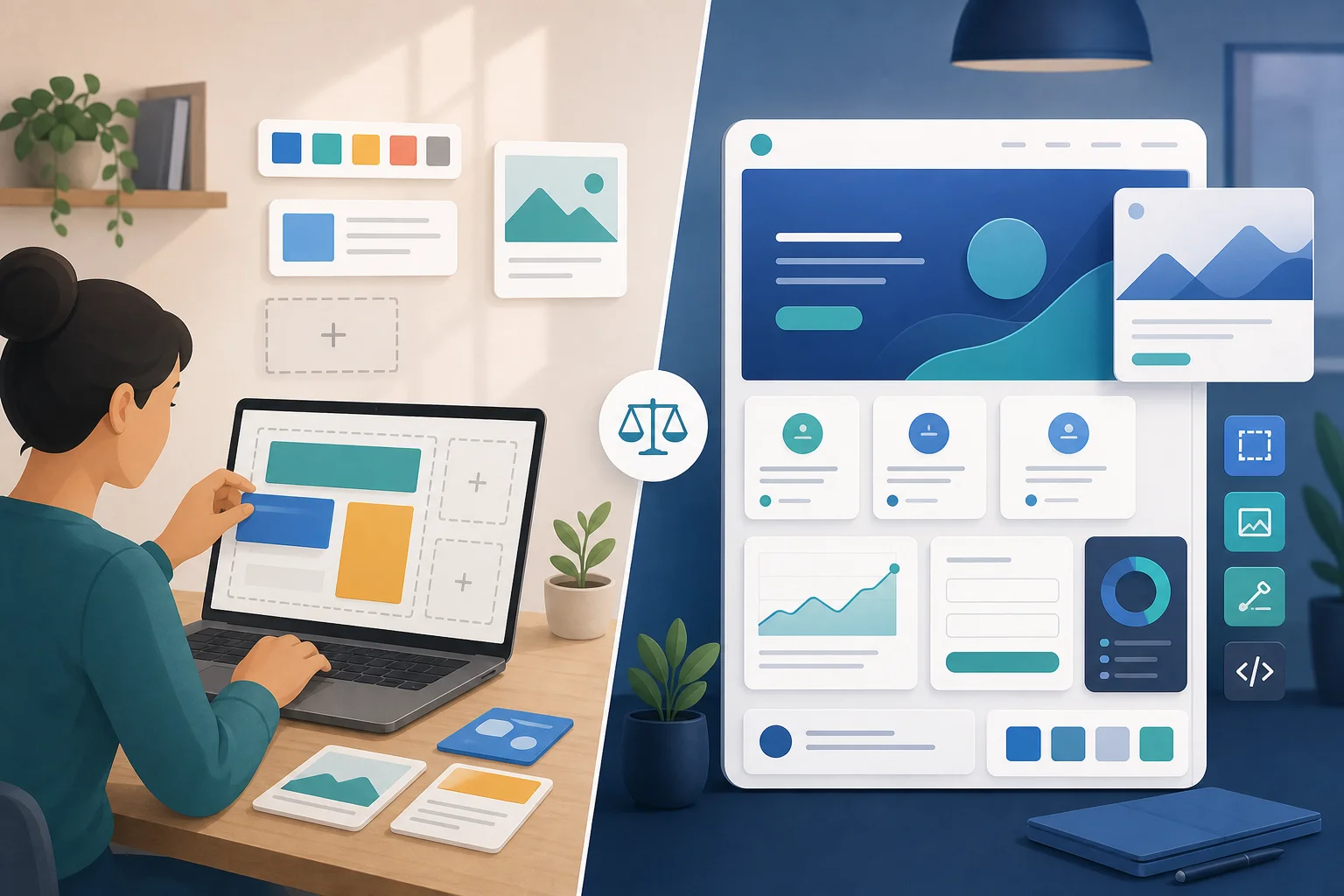
DIY Website Builder vs Custom Web Design for Pennsylvania Small Businesses
For many Pennsylvania small business owners, the website decision starts with one question: should you build it yourself with a website builder, or hire a professional web designer?
Both options can work. A DIY website builder can be a practical starting point if you need something simple and have time to learn the platform. Custom web design is usually the better fit when your website needs to generate leads, rank locally, reflect your brand, or support a more serious growth plan.
This guide breaks down the tradeoffs so you can choose the option that fits your budget, timeline, and goals.
What is a DIY website builder?
A DIY website builder is a platform that lets you create a website using templates, drag-and-drop sections, and built-in hosting. Common examples include Wix, Squarespace, Shopify, and similar tools.
DIY builders are popular because they make it possible to launch a basic website without writing code. For a brand-new business, side project, or simple brochure site, that can be useful.
The main tradeoff is that you are responsible for everything: structure, copywriting, design choices, search engine optimization, mobile layout, conversion strategy, and ongoing updates.
What is custom web design?
Custom web design means your website is planned and built around your business instead of starting from a generic template. A professional designer or agency helps with layout, messaging, user experience, technical structure, and conversion paths.
For Pennsylvania small businesses, custom design is often about more than looking polished. It helps your website answer local customer questions, guide people toward calls or quote requests, and support services like [custom web design](/custom-web-design-services), [SEO optimization](/seo-optimization-services), and [website maintenance](/website-support-maintenance).
Quick comparison: DIY builder vs custom web design
A DIY website builder usually wins when:
- You need a very simple site quickly.
- You have a small budget and more time than money.
- You are comfortable writing your own content.
- You do not need advanced SEO, integrations, or custom layouts.
- Your site is mostly informational and low-risk.
Custom web design usually wins when:
- Your website needs to generate calls, leads, bookings, or sales.
- You serve a specific local market in Pennsylvania.
- You need stronger branding than a template can provide.
- You want SEO-friendly page structure from the beginning.
- You need help with copy, layout, speed, mobile experience, or conversion strategy.
- Your current site looks outdated or is not performing.
Cost: which option is cheaper?
DIY website builders usually look cheaper at first. You pay a monthly platform fee, choose a template, and build the site yourself. But the real cost includes your time, add-ons, app fees, stock assets, copywriting, troubleshooting, and future redesign work if the first version does not perform.
Custom web design costs more upfront, but it can save time and reduce the amount of trial-and-error. If your website helps close even a few extra jobs, appointments, or projects, the return can be much stronger than the initial savings from doing everything yourself.
If you are comparing budget ranges, start with this [small business web design cost guide](/small-business-web-design-cost) for a clearer picture of what affects pricing.
SEO: can a DIY website rank on Google?
Yes, a DIY website can rank on Google, but the platform alone does not make that happen. Ranking depends on page structure, content quality, internal links, local relevance, technical performance, and whether your site answers search intent better than competing pages.
Many DIY sites struggle because they launch with:
- Thin service pages
- Generic template copy
- Weak title tags and meta descriptions
- Slow images or bloated page sections
- Missing local signals
- Poor internal linking
- No content strategy beyond the homepage
If your goal is local visibility, especially for searches like web design, contractor services, dental services, salons, restaurants, or home services in Pennsylvania, SEO planning matters. A professional site should make it easier to connect your service pages, location pages, and blog content into one clear search-friendly structure.
Design and branding: template vs tailored experience
Templates can look good, but they are built to serve many types of businesses. That means they often need heavy editing before they truly fit your offer, audience, and brand.
Custom web design gives you more control over:
- Visual style and brand consistency
- Homepage flow
- Service-page layout
- Calls to action
- Trust signals and testimonials
- Mobile readability
- Local proof and service-area messaging
For a small business, the goal is not just a pretty website. The goal is a site that helps visitors understand what you do, why they should trust you, and what to do next.
Time: DIY can be fast, but only if you know what to build
A DIY builder can be fast if you already have your content, branding, photos, page structure, and SEO basics ready. If not, the project can turn into weeks of tweaking fonts, rewriting sections, fixing mobile layouts, and wondering why the contact form looks weird.
A professional web design process usually takes more planning upfront, but that planning is part of the value. Your pages are mapped around the customer journey instead of being assembled section by section with crossed fingers and caffeine.
Tiny website goblin truth: drag-and-drop is easy; deciding what should actually go on the page is the hard part.
When a DIY website builder makes sense
A DIY website builder may be the right move if:
- You are testing a new business idea.
- You only need a basic online presence.
- Your budget is extremely limited.
- You enjoy learning website tools.
- You do not rely heavily on Google traffic yet.
In this case, keep the site simple. Focus on a clear homepage, a strong contact page, accurate business information, and a few useful service sections.
When custom web design is the better move
Custom web design is usually worth it when your website is tied directly to revenue. If your site needs to help people call, book, request a quote, or trust you before contacting you, it should be treated like a business asset.
It is especially useful for:
- Local service businesses
- Contractors and home-service companies
- Dental and medical offices
- Law firms
- Ecommerce brands
- Professional service providers
- Businesses with outdated websites
- Companies expanding into new Pennsylvania markets
If that sounds like your situation, a professionally planned [small business website design](/small-business-website-design-pennsylvania) can give you a stronger foundation than a generic template.
Watch for these red flags before choosing DIY
Before committing to a DIY builder, ask yourself:
- Do I know what pages my site needs?
- Can I write clear copy for each service?
- Do I understand basic SEO titles and descriptions?
- Can I make the mobile version look good?
- Do I know how to compress and size images?
- Can I set up analytics and conversion tracking?
- Do I have time to maintain the site after launch?
If most answers are no, DIY may still work, but expect a learning curve.
A practical decision framework
Choose DIY if your main goal is to get a simple website online with minimal upfront cost.
Choose custom web design if your main goal is to create a website that supports marketing, local SEO, trust, and lead generation.
Another way to think about it: DIY is usually a tool. Custom web design is a strategy plus implementation.
Final recommendation for Pennsylvania small businesses
If your business is early-stage and you just need a basic presence, a DIY builder can be a reasonable first step.
But if your website needs to help you compete locally, attract better leads, explain your services, or support long-term SEO, custom web design is usually the smarter investment.
Sleek Website Design helps Pennsylvania small businesses build fast, mobile-friendly, SEO-ready websites that are designed around real business goals. If you are not sure which route fits your situation, request a free website quote and we can help you compare your options without the tech fog machine.